
16 Chrome Extensions Hacked, Exposing Over 600,000 Users to Data Theft

î „Ravie Lakshmanan

                                                                                                                                                                                                                                                                                               A new attack campaign has targeted known Chrome browser extensions, leading to at least 16 extensions being compromised and exposing over 600,000 users to data exposure and credential theft.

The attack targeted publishers of browser extensions on the Chrome Web Store via a phishing campaign and used their access permissions to insert malicious code into legitimate extensions in order to steal cookies and user access tokens.

The first company to be known to have been exposed was cybersecurity firm Cyberhaven.

On December 27, Cyberhaven disclosed that a threat actor compromised its browser extension and injected malicious code to communicate with an external Command and Control (C&C) server located on the domain cyberhavenext[.]pro, download additional configuration files, and exfiltrate user data.

“Browser extensions are the soft underbelly of web security,” says Or Eshed, CEO of LayerX Security, which specializes in browser extension security. “Although we tend to think of browser extensions as harmless, in practice, they are frequently granted extensive permissions to sensitive user information such as cookies, access tokens, identity information, and more.

“Many organizations don’t even know what extensions they have installed on their endpoints, and aren’t aware of the extent of their exposure,” says Eshed.

Once news of the Cyberhaven breach broke, additional extensions that were also compromised and communicating with the same C&C server were quickly identified.

Jamie Blasco, CTO of SaaS security company Nudge Security, identified additional domains resolving to the same IP address of the C&C server used for the Cyberhaven breach.

Additional browser extensions currently suspected of having been compromised include:

  • AI Assistant – ChatGPT and Gemini for Chrome
  • Bard AI Chat Extension
  • GPT 4 Summary with OpenAI
  • Search Copilot AI Assistant for Chrome
  • TinaMInd AI Assistant
  • Wayin AI
  • VPNCity
  • Internxt VPN
  • Vindoz Flex Video Recorder
  • VidHelper Video Downloader
  • Bookmark Favicon Changer
  • Castorus
  • Uvoice
  • Reader Mode
  • Parrot Talks
  • Primus

These additional compromised extensions indicate that Cyberhaven was not a one-off target but part of a wide-scale attack campaign targeting legitimate browser extensions.

Analysis of compromised Cyberhaven indicates that the malicious code targeted identity data and access tokens of Facebook accounts, and specifically Facebook business accounts:

User data collected by the compromised Cyberhaven browser extension (source: Cyberhaven)

Cyberhaven says that the malicious version of the browser extension was removed about 24 hours after it went live. Some of the other exposed extensions have also already been updated or removed from the Chrome Web Store.

However, the fact the extension was removed from the Chrome store doesn’t mean that the exposure is over, says Or Eshed. “As long as the compromised version of the extension is still live on the endpoint, hackers can still access it and exfiltrate data,” he says.

Security researchers are continuing to look for additional exposed extensions, but the sophistication and scope of this attack campaign have upped the ante for many organizations of securing their browser extensions.

read more

Chinese hackers said to have collected audio of American calls

The hackers are said to be part of a Chinese government-affiliated group that American researchers have dubbed Salt Typhoon.

 and 

Chinese state-affiliated hackers have collected audio from the phone calls of U.S. political figures, according to three people familiar with the matter. Those whose calls have been intercepted include an unnamed Trump campaign adviser, said one of the people.

The hackers are said to be part of a Chinese government-affiliated group that American researchers have dubbed Salt Typhoon and were able to collect audio on a number of calls as part of a wide-ranging espionage operation that began months ago, according to the people, who spoke on the condition of anonymity because a federal investigation is underway. The government is still seeking to determine how much audio the hackers have, one of the people said.

They were also able to access unencrypted communications, including text messages, of the individual, the people said. End-to-end encrypted communications such as those on the Signal platform are believed to have not been hacked, they said.

The development heightens concerns over the extent of the infiltration as the 2024 election is in high gear as well as the potential threat to long-term national security.

The FBI declined to comment on the matter.

The FBI and other U.S. agencies are still investigating the full extent and nature of the espionage campaign. The hackers targeted the phones of former president Donald Trump, who is running to regain the White House, and his running mate JD Vance, the New York Times first reported Friday. They were thought to have targeted information about call logs, and there is no evidence so far that the hackers listened in on calls of the two Republicans at the top of the ticket.

As previously reported, Democrats were also targeted in the hacking efforts, including the staff of Senate Majority Leader Charles E. Schumer (D-New York), according to another person familiar with the matter.

The Salt Typhoon group is also thought to have targeted the system that tracks lawful requests for wiretaps made by the federal government of carriers. The motive there could be to figure out who the FBI and other federal agencies have under surveillance, said people familiar with the matter.

The matter is so serious that the White House earlier this month set up an emergency multiagency team to ensure all relevant agencies have visibility into the investigation. The establishment of a “unified coordination group” triggers a separate mandatory investigation by a public-private Cyber Safety Review Board, which in this case will probe the lapses that led to the intrusions. The board is led by the Department of Homeland Security and includes cyber experts from industry. It’s unclear when the probe will begin, officials said.

The wide-ranging operation has involved at least 10 telecom companies, including major carriers such as AT&T, Verizon and Lumen.

At least one U.S. official was notified late last week that a personal cellphone had been accessed by the Salt Typhoon hackers, said one of the people familiar with the matter. The hackers were targeting phone logs, SMS text messages and other data on the device, said the person. It was not clear whether audio calls were successfully intercepted for that official, the person said.

read more

North Korean IT Workers in Western Firms Now Demanding Ransom for Stolen Data

î „Ravie Lakshmanan

North Korean information technology (IT) workers who obtain employment under false identities in Western companies are not only stealing intellectual property, but are also stepping up by demanding ransoms in order to not leak it, marking a new twist to their financially motivated attacks.

“In some instances, fraudulent workers demanded ransom payments from their former employers after gaining insider access, a tactic not observed in earlier schemes,” Secureworks Counter Threat Unit (CTU) said in an analysis published this week. “In one case, a contractor exfiltrated proprietary data almost immediately after starting employment in mid-2024.”

The activity, the cybersecurity company added, shares similarities with a threat group it tracks as Nickel Tapestry, which is also known as Famous Chollima and UNC5267.

The fraudulent IT worker scheme, orchestrated with the intent to advance North Korea’s strategic and financial interests, refers to an insider threat operation that entails infiltrating companies in the West for illicit revenue generation for the sanctions-hit nation.

These North Korean workers are typically sent to countries like China and Russia, from where they pose as freelancers looking for potential job opportunities. As another option, they have also been found to steal the identities of legitimate individuals residing in the U.S. to achieve the same goals.

They are also known to request for changes to delivery addresses for company-issued laptops, often rerouting them to intermediaries at laptop farms, who are compensated for their efforts by foreign-based facilitators and are responsible for installing remote desktop software that allow the North Korean actors to connect to the computers.

What’s more, multiple contractors could end up getting hired by the same company, or, alternatively, one individual could assume several personas.

Secureworks said it has also observed cases where the fake contractors sought permission to use their own personal laptops and even caused organizations to cancel the laptop shipment entirely because they changed the delivery address while it was in transit.

Ransom for Stolen Data

“This behavior aligns with Nickel Tapestry tradecraft of attempting to avoid corporate laptops, potentially eliminating the need for an in-country facilitator and limiting access to forensic evidence,” it said. “This tactic allows the contractors to use their personal laptops to remotely access the organization’s network.”

In a sign that the threat actors are evolving and taking their activities to the next level, evidence has come to light demonstrating how a contractor whose employment was terminated by an unnamed company for poor performance resorted to sending extortion emails including ZIP attachments containing proof of stolen data.

“This shift significantly changes the risk profile associated with inadvertently hiring North Korean IT workers,” Rafe Pilling, Director of Threat Intelligence at Secureworks CTU, said in a statement. “No longer are they just after a steady paycheck, they are looking for higher sums, more quickly, through data theft and extortion, from inside the company defenses.”

To tackle the threat, organizations have been urged to be vigilant during the recruitment process, including conducting thorough identity checks, performing in-person or video interviews, and be on the lookout for attempts to re-route corporate IT equipment sent to the contractors declared home address, routing paychecks to money transfer services, and accessing the corporate network with unauthorized remote access tools.

“This escalation and the behaviors listed in the FBI alert demonstrate the calculated nature of these schemes,” Secureworks CTU said, pointing out the workers’ suspicious financial behavior and their attempts to avoid enabling video during calls.

“The emergence of ransom demands marks a notable departure from prior Nickel Tapestry schemes. However, the activity observed prior to the extortion aligns with previous schemes involving North Korean workers.”

read more

Feds unmask duo running one of the most prolific hacker gangs

The Department of Justice has charged and arrested two Sudanese brothers with operating Anonymous Sudan, a hacker group known for destructive website takedowns.

Why it matters: The indictment, unsealed Wednesday, paints the clearest picture of who was running the mysterious Anonymous Sudan hacking group — which has launched more than 35,000 attacks in the last year against hospitals, government offices and other major organizations.

Driving the news: A grand jury indicted Ahmed Salah Yousif Omer and Alaa Salah Yusuuf Omer with a count of conspiracy to damage protected computers.

  • Ahmed Omer was also charged with three counts of damaging protected computers.
  • The FBI and the U.S. Attorney’s Office for the Central District of California seized Anonymous Sudan’s hacking tool, according to a press release.
  • The Washington Post reported that officials arrested the duo abroad in March.

Threat level: Anonymous Sudan’s attacks have caused more than $10 million in damage to U.S. organizations, according to federal officials.

  • Anonymous Sudan’s victim list spans sectors and includes several high-profile names: Cloudflare, Microsoft, OpenAI and even the FBI itself.
  • Cedars-Sinai Medical Center in Los Angeles had to redirect emergency room patients to other hospitals for treatment.

The big picture: Anonymous Sudan has been a mystery to security researchers for a little more than a year.

  • The group is mostly politically motivated, unlike other cybercriminal groups where money is the prime motivator.
  • But the group has been far more prolific than the typical political hacking group. At times, security researchers had even assumed the group was a front for pro-Russia political hackers.
  • However, officials told the Post they don’t believe a third party, including a government, was financing or supporting the group’s work.

What they’re saying: “What’s unusual is the predominance of the ideological motive, with financial sprinkled in,” Martin Estrada, U.S. attorney for the Los Angeles region, told the Post.

How it works: Anonymous Sudan targeted victims in distributed denial-of-service attacks — where hackers overload internet-enabled devices with bot traffic until they’re inaccessible.

  • While suffering a website outage might not sound too bad, the repercussions can be huge. Customers may not be able to make payments online and corporations may not be able to access cloud servers.
  • Anonymous Sudan would demand victims pay a ransom to make the attack end, according to court filings.
  • Some of these victims sustained millions of dollars in losses from these attacks, according to a criminal complaint unsealed Wednesday.

Between the lines: Anonymous Sudan was also selling its tool to other hacking groups looking to launch their own large-scale DDoS attacks, according to the complaint.

  • More than 100 users have used the tool — known as Godzilla Botnet, Skynet Botnet and InfraShutdown — to deploy their own DDoS attacks, per federal officials.
  • This is also unusual: Building and selling hacker tools is more common in the cybercrime world and rarely seen in the political hacking space.

Zoom in: The private sector played a prominent role in helping the FBI identify the people running this group.

  • PayPal’s own internal investigation after its attack uncovered certain accounts tied to Anonymous Sudan, according to the complaint.
  • Those accounts then helped the FBI identify potential email addresses linked to Ahmed Omer, specifically, according to the affidavit.

What’s next: If convicted, Ahmed Omer could face a maximum sentence of life in prison, while Alaa Omer could face a maximum of five years.

read more

Undercover North Korean IT workers now steal data, extort employers

By

North Korean IT professionals who trick Western companies into hiring them are stealing data from the organization’s network and asking for a ransom to not leak it.

Dispatching IT workers to seek employment at companies in wealthier nations is a tactic that North Korea has been using for years as a means to obtain privileged access for cyberattacks or to generate revenue for the country’s weapons programs.

Researchers at cybersecurity company Secureworks uncovered the extortion component during multiple investigations of such fraudulent schemes.

After the employment of a North Korean national with access to proprietary data (as part of their contractor role) terminated, the company would receive the first extortion email, the researchers explain.

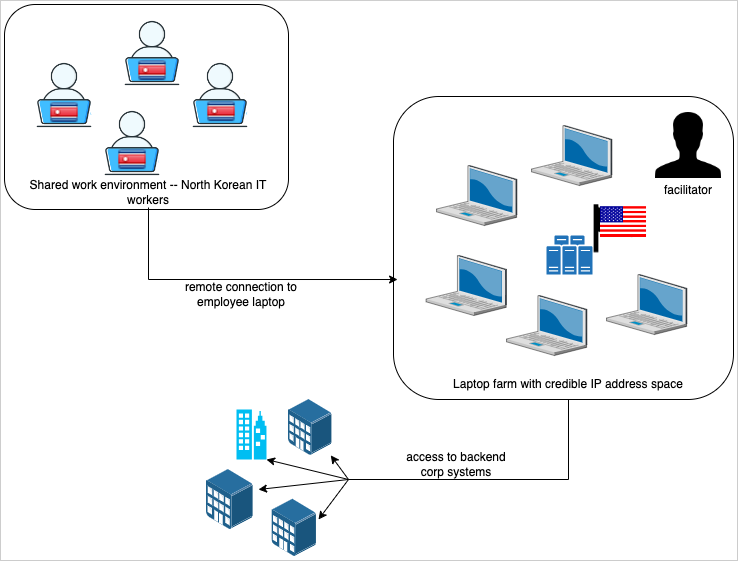
To obtain the job and avoid raising suspicions afterwards, the fraudulent IT workers used a false or stolen identity and relied on laptop farms to route traffic between their real location and the company through a U.S.-based point.

They also avoided video during calls or resorted to various tricks while on the job to hide their face during video conferences, such as using artificial intelligence tools.

Overview of the scheme
Source: Secureworks

In July, American cybersecurity company KnowBe4 revealed that they were among the hundreds of victimized companies, and in their case, the threat actor attempted to install an infostealer on the company’s computer.

Secureworks tracks the group organizing and coordinating North Korea’s IT worker army as “Nickel Tapestry,” while Mandiant uses the UNC5267 name.

One example of a Nickel Tapestry campaign in mid-2024 that Secureworks investigated is that of a company that had proprietary data stolen almost immediately after employing an external contractor

The data was transferred to a personal Google Drive cloud storage using the company’s virtual desktop infrastructure (VDI).

After terminating the employment due to poor performance, the company began receiving extortion emails from external Outlook and Gmail addresses containing samples of the stolen data in ZIP archives.

The threat actors demanded a six-figure ransom to be paid in cryptocurrency in exchange to not leaking the data publicly.

Secureworks’ investigation revealed that Nickel Tapestry had used Astrill VPN and residential proxies to mask their real IP address during the malicious activities, while AnyDesk was used for remote accessing the systems.

The researchers warn that North Korean IT workers often coordinate to refer one another to companies.

Organizations should be cautious when hiring remote workers or freelancers, and look for signs of fraud like changes in payment accounts and laptop shipment addresses, submission of generic-looking resumes, atypical correspondence hours, and unwillingness to enable camera during interviews.

read more

Infostealers Waltz Through macOS to Grab Crypto Wallets, Browser Creds

Ironically, Macs’ lower risk profile may make them more susceptible to any given threat than the average Windows or Linux system.

A new infostealer is trying to ride the coattails of one of the most prevalent malware tools on the planet, taking advantage of some inherent security shortcomings in macOS environments.

In a new blog post, Cado Security discusses “Cthulhu Stealer,” a new cybercrime tool making the rounds lately. It’s designed to nab cryptocurrency wallet and gaming credentials, as well as browser data. It isn’t particularly sophisticated, perhaps because it doesn’t have to be. Atomic Stealer — Cthulhu’s progenitor — has proven as much. In the past couple of years, this basically average stealer has become one of the most prevalent malwares across the globe. Perhaps, experts suggest, that has to do with some of the ways in which the security community has looked past Macs in the past.

Case Study: Cthulhu Stealer

Cthulhu Stealer is an Apple disk image (DMG) written in Golang. It typically arrives in front of a victim’s eyeballs masked as a legitimate software program, like the CleanMyMac maintenance tool or the Grand Theft Auto video game.

When opened, the program asks for the victim’s system password and, illogically, their Metamask cryptocurrency wallet password.

“It should look suspicious to users, but sometimes people download stuff and they might not be thinking,” notes Tara Gould, threat researcher at Cado Security. With Cthulhu’s target demographic in particular, “They could be younger, or maybe not as well-versed in computers. There’s a whole host of reasons why it may not potentially flag as suspicious.”

Once planted, the program gathers system data, such as its IP address, OS version, and various hardware and software information. Then it goes after its real aim: crypto, game account, and browser credentials. Targeted apps include the Coinbase, Binance, and Atomic crypto wallets, Firefox cookies, and Battle.net and Minecraft user data.

Despite running for $500 per month on cybercrime forums, Cthulhu Stealer is essentially unsophisticated, without any standout stealth techniques, and largely indistinguishable from at least one other commercially available offering in the underground.

The Road Atomic Stealer Paved

The most notable feature of Cthulhu Stealer is how closely it copies Atomic Stealer. Not only do they share many of the same functionalities and features, but Cthulhu Stealer even includes some of the same typos in Atomic Stealer’s code.

Atomic Stealer isn’t so remarkable itself. Previously, Dark Reading noted its lack of a persistence mechanism, and characterized it as “smash and grab” by nature. Still, it’s no wonder that other malware authors might want to copy it, since it’s one of the most successful infostealers in the world today.

In a report last month, Red Canary ranked it as the sixth most prevalent malware in the wild today, tied with the popular SocGholish and Lumma, and the ubiquitous Cobalt Strike. Its sixth place finish is actually a step down from previous Red Canary reports, which have included Atomic Stealer in its top 10 lists for the entirety of 2024 thus far.

“The fact that any macOS threat would make the top 10 is pretty staggering,” notes Brian Donohue, principal information security specialist with Red Canary. “I would venture to guess that any organization that has a meaningful footprint of macOS devices probably has Atomic Stealer lurking somewhere in their environment.”

How Enterprises Should Handle macOS Threats

Threats to macOS are distinctly less common than to Windows and Linux, with Elastic data from 2022 and 2023 suggesting that only around 6% of all malware can be found on these systems.

“Windows is still targeted the most, because large corporations all tend to still be very Windows-heavy, but that is shifting. A lot of enterprises are starting to increase the amount of Macs they have, so it is definitely going to become more of an issue,” Gould says.

Hackers aren’t all jumping on the bandwagon yet, but there is growing interest, perhaps because there’s so little interest on the part of defenders.

In an email to Dark Reading, Jake King, head of threat and security intelligence at Elastic, indicated that threats to Macs have risen less than 1% over the past year, adding, “While we’re not observing significant growth patterns that indicate enterprise-specific targeting of MacOS, it may be attributed to a lower volume of telemetry acquired from this OS. We have observed several novel approaches to exploiting vulnerabilities over the calendar year that indicate adversarial interest across a number of campaigns.” In other words: the data may indicate a lack of interest in macOS from attackers, or from defenders.

If runaway successes like Atomic Stealer do inspire more hackers to move operating systems, defenders will be working from a disadvantageous position, thanks to years of disinterest from the security community.

As Donohue explains, “A lot of enterprises adopt macOS systems for engineers and administrators, so a lot of the people who are using macOS machines are, by default, either highly privileged or dealing with sensitive information. And my suspicion is that there is less expertise in macOS threats across those organizations.”

There’s also less tooling, Donohue adds. “Take something like EDR, as an example. These started out as tools for protecting Windows systems and then were later co-opted into being tools for protecting macOS systems as well. And Windows machines have really robust application control policies, but there isn’t really similar functionality in macOS Gatekeeper (which is roughly analogous to Windows Defender). It’s pretty good at finding malicious binaries and creating YARA rules and signatures for them, but a lot of malware developers have been able to sidestep it.”

Elastic’s King adds, “Default operating system controls, while effective, are likely not evolving at a rate alongside adversarial behaviors.” For this reason, King says, “Ensuring sensible access permissions, sufficient hardening controls, and instrumentation that allows for organizations to observe or prevent threats on macOS systems remains important.”

read more
Trustpilot
The rating of livingsafeonline.com at Trustprofile Reviews is 9.1/10 based on 13 reviews.
Verified by MonsterInsights