

US Treasury hacked: Are China and the US stepping up their cyberwar?
Department of the Treasury calls cyberattack a ‘major incident’, accuses China-backed hackers.
ByÂ
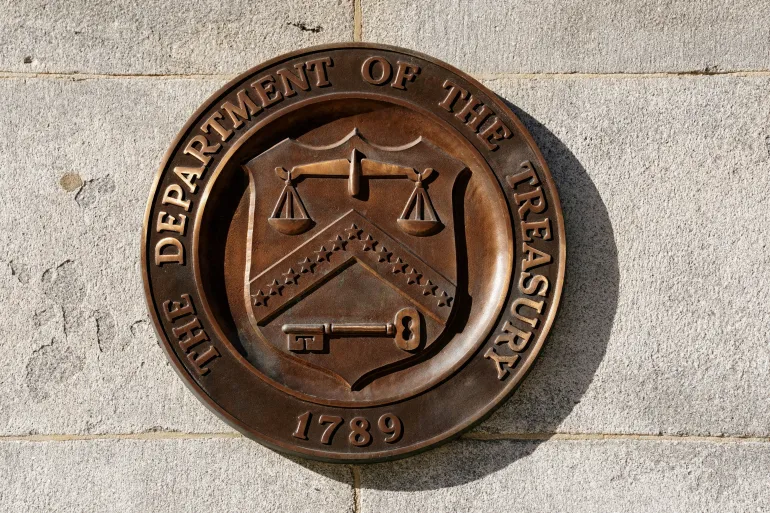
The United States Department of the Treasury on Monday blamed China for breaching its network and gaining access to information that includes unclassified documents.
Beijing has denied the allegation, calling it “groundlessâ€.
Keep reading
list of 4 items
US says ‘Salt Typhoon’ Chinese hacking group behind major metadata theft
Did artificial intelligence shape the 2024 US election?
US sanctions China cyber firm for potentially deadly ransomware attack
China blamed by US for Treasury Department hack
end of list
The alleged hacking comes weeks after Beijing accused Washington of carrying out two cyberattacks on Chinese technology firms.
With Washington and Beijing trading blame, we assess the history of cyberwarfare between the world’s two largest economies and whether it has intensified.
Who hacked the US Treasury Department?
The US Treasury Department accused Chinese state-sponsored hackers of breaking into its system this month and accessing employee workstations and unclassified documents.
The department said the hackers gained access by overriding a security key used by third-party cybersecurity provider BeyondTrust, which provides technical support remotely to Treasury employees.
The Treasury Department made these details public on Monday in a letter to the US Congress. The attack was caused by “a China-based Advanced Persistent Threat (APT) actorâ€, the letter said.
The department, however, did not specify the number of workstations compromised, the nature of the files, the exact timeframe of the hack and the confidentiality level of the stations compromised.
On December 8, Treasury was alerted about a hack by BeyondTrust. The BBC reported that BeyondTrust first suspected unusual activity on December 2 but took three days to determine it was hacked.
How did the US Treasury Department respond?
The department said there is no evidence that the hackers still have access to department information and the compromised BeyondTrust has been taken offline.
It is assessing the impact of the hack with the assistance of the US Cybersecurity and Infrastructure Security Agency (CISA) and the Federal Bureau of Investigation (FBI). The hack is being investigated as a “major cybersecurity incidentâ€.
The department’s letter to Congress added that supplemental information about the attack would be sent to US lawmakers in 30 days.
“Over the last four years, Treasury has significantly bolstered its cyber defence, and we will continue to work with both private and public sector partners to protect our financial system from threat actors,†a spokesperson for the department said in a separate statement.
How has China responded?
China has denied the department’s accusations, and its Ministry of Foreign Affairs said Beijing condemns all forms of hacker attacks.
“We have stated our position many times regarding such groundless accusations that lack evidence,†ministry spokesperson Mao Ning was quoted as saying by the AFP news agency.
A spokesperson for the Chinese embassy in the US, Liu Pengyu, denied the department’s allegations. “We hope that relevant parties will adopt a professional and responsible attitude when characterising cyber-incidents, basing their conclusions on sufficient evidence rather than unfounded speculation and accusations,†he said, according to a BBC report.
“The US needs to stop using cybersecurity to smear and slander China and stop spreading all kinds of disinformation about the so-called Chinese hacking threats.â€
Are the US and China ramping up cyberattacks against each other?
While the US has blamed China for cyberattacks over the years, Beijing has also accused Washington of hacking its critical cyber-infrastructure in recent years.
Here’s a brief timeline of recent cyberattacks claimed by the two nations:
On December 18, China’s National Computer Network Emergency Response Technical Team/Coordination Centre of China (CNCERT/CC) released a statement saying two US cyberattacks since May 2023 tried to “steal trade secrets†from Chinese technology firms.
On December 5, US Deputy National Security Adviser Anne Neuberger said a Chinese hacking group called Salt Typhoon had obtained communications of senior US government officials but classified information was not compromised.
A month earlier, on November 13, the FBI and CISA said they had uncovered a broad cyberespionage campaign carried out by China-linked hackers.
The US alleged that the hackers had compromised “private communications of a limited number of individualsâ€. While it did not specify who these individuals were, they were “primarily involved in government or political activityâ€, the FBI and CISA said.
Weeks before the US elections in November, the FBI launched an investigation after reports alleged Chinese hackers had targeted mobile phones of President-elect Donald Trump and Vice President-elect JD Vance as well as people associated with Kamala Harris, the Democratic presidential candidate in the race.
In July 2023, US tech giant Microsoft said the China-based hacking group Storm-0558 breached email accounts at about 25 organisations and government agencies. The breached accounts included those belonging to US Department of State staff.
In March, the US and United Kingdom accused China of carrying out a sweeping cyberespionage campaign that allegedly hit millions of people, including lawmakers, journalists and defence contractors. The two countries slapped sanctions on a Chinese company after the incident. A month before, US authorities said they had dismantled a China-sponsored hacker network called Volt Typhoon.
In response, China called the charges “completely fabricated and malicious slandersâ€.
In March 2022, China said it experienced a series of cyberattacks that mostly traced back to US addresses. Some were also traced back to the Netherlands and Germany, according to CNCERT/CC.
- Now PlayingVideo Duration 03 minutes 57 seconds

China cyber-attacks: Beijing calls UK & US accusations ‘groundless
Why are cyberattacks launched?
State-sponsored actors are regularly accused of launching cyberattacks against adversaries that range from state institutions to politicians and activists. They aim to gain unauthorised access to confidential data and trade secrets or disrupt economies and critical infrastructure.
“The US and China have had a history of using cyberdefence to further their national security aims,†Rebecca Liao, the Co-Founder and CEO at web3 protocol Saga, told Al Jazeera.
“While espionage against state actors is an accepted practice, the US has protested against China’s rampant cyberattacks against US commercial entities,†said Liao, who was a member of President Joe Biden’s 2020 and Hillary Clinton’s 2016 presidential campaigns, advising on China, technology and Asia economic policy.
“It is obviously not diplomatically wise to build a track record of resorting to espionage. That’s why Beijing has been so swift to deny all allegations.â€
With the development of digital technology, cyberattacks are on the rise worldwide, according to the German Institute for International and Security Affairs (SWP). Data from the SWP shows that cyberattacks went up from 107 in 2014 to 723 in 2023.
Cyberattacks are also carried out by individuals or organised groups who want to steal data and money.
How can countries protect themselves from cyberattacks?
The US and China “should spearhead a treaty on the responsible use of the cyberspaceâ€, wrote researchers Asimiyu Olayinka Adenuga and Temitope Emmanuel Abiodun from the Political Science Department at Nigeria’s Tai Solarin University in an article published this year.
They cited the example of the treaties signed between the US and Soviet Union as a result of the Strategic Arms Limitations Talks, SALT I and SALT II, in 1972 and 1979. The two Cold War superpowers signed the treaties to establish US-Soviet stability by limiting their production of nuclear weapons.
In their article, the Tai Solarin researchers added that there is a need for further technological development, particularly in quantum computing, that will make it harder to execute cyberattacks.
Victor Atkins, a fellow with the Indo-Pacific Security Initiative of the US think tank Atlantic Council, wrote in a February article that the US “should launch an expansive new multilateral cyber threat intelligence sharing coalition in the Indo-Pacific†to combat cyberattacks from China.
“A decade ago, there were some suggestions about convening an international body around cybersecurity to come up with standards or codes of conduct that participating nations would abide by,†Liao, the tech expert, said.
“However, none of these efforts have yielded fruit, and it is up to each individual country to protect against cyberattacks.â€
Governments currently are working on developing cybersecurity infrastructure such as firewalls to protect themselves from cyberattacks such as hacking.
An article published by the University of Miami added that countries employ other practices to counter cyberthreats. These include testing these cyberthreats in a simulated environment. “Cyber teams constantly undergo training exercises, similar to the military,†the article said.