

Fake Social Security Statement emails trick users into installing remote tool

by Pieter Arntz:

Fake emails pretending to come from the US Social Security Administration (SSA) try to get targets to install ScreenConnect, a remote access tool.

This campaign was flagged and investigated by the Malwarebytes Customer Support and Research teams.

ScreenConnect, formerly known as ConnectWise Control, is a remote support and remote access platform widely used by businesses to facilitate IT support and troubleshooting. It allows technicians to remotely connect to users’ computers to perform tasks such as software installation, system configuration, and to resolve issues.

Because ScreenConnect provides full remote control capabilities, an unauthorized user with access can operate your computer as if they were physically present. This includes running scripts, executing commands, transferring files, and even installing malware—all potentially without you realizing.

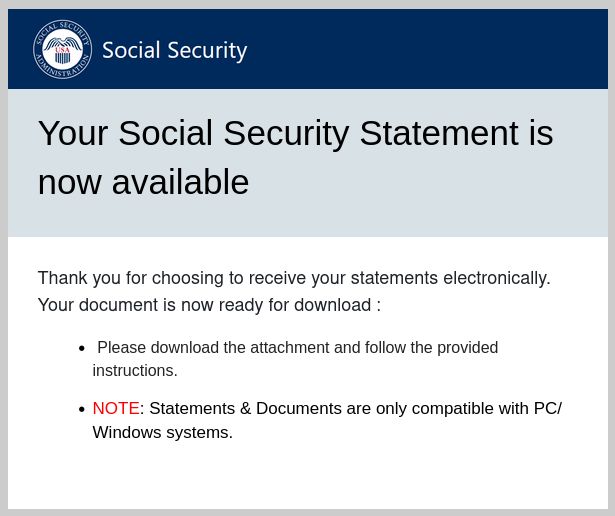
This makes ScreenConnect a dangerous tool in the hands of cybercriminals. A phishing group dubbed Molatori—because of the domains they use to host the ScreenConnect client—has been found to lure their targets into installing the ScreenConnect clients by sending emails pretending to come from the Social Security Administration (SSA):

example SSA email

“Your Social Security Statement is now available
Thank you for choosing to receive your statements electronically.
Your document is now ready for download:

  • Please download the attachment and follow the provided instructions.
  • NOTE: Statements & Documents are only compatible with PC/Windows systems.”

There are some variations to this mail in circulation but the example above shows how legitimate these emails look.

The link in the email leads to the ScreenConnect support.Client.exe, but was found under several misleading names like ReceiptApirl2025Pdfc.exe, and SSAstatment11April.exe.

After cybercriminals install the client on the target’s computer, they remotely connect to it and immediately begin their malicious activities. They access and exfiltrate sensitive information such as banking details, personal identification numbers, and confidential files. This stolen data can then be used to commit identity theft, financial fraud, and other harmful acts. Experts have identified financial fraud as the primary objective of the Molatori group.

There are several circumstances that make this campaign hard to detect:

  • The cybercriminals send phishing emails from compromised WordPress sites, so the domains themselves appear legitimate and not malicious.
  • They often embed the email content as an image, which prevents email filters from effectively scanning and blocking the message.
  • ScreenConnect is a legitimate application which happens to be abused because of its capabilities.

What we can do

When receiving unsolicited emails there are a few necessary precautions you can take to avoid falling for phishing:

  • Verify the source of the email through independent sources.
  • Don’t click on links until you are sure they are non-malicous.
  • Don’t open downloaded files or attachments until you are sure they are safe.
  • Use an up-to-date and active anti-malware solution.
  • If you suspect an email isn’t legitimate, take a name or some text from the message and put it into a search engine to see if any known phishing attacks exist using the same methods.

Malwarebytes users are protected

Malwarebytes will detect suspicious instances of the ScreenConnect client as RiskWare.ConnectWise.CST.

Malwarebytes blocks RiskWare.ConnectWise.CST

And blocks connections to these associated domains:

  • atmolatori[.]icu
  • gomolatori[.]cyou
  • molatoriby[.]cyou
  • molatorier[.]cyou
  • molatorier[.]icu
  • molatoriist[.]cyou
  • molatorila[.]cyou
  • molatoriora[.]cyou
  • molatoriora[.]icu
  • molatoripro[.]cyou
  • molatoripro[.]icu
  • molatorisy[.]cyou
  • molatorisy[.]icu
  • onmolatori[.]icu
  • promolatori[.]icu
  • samolatori[.]cyou
  • samolatori[.]icu
  • umolatori[.]icu

We don’t just report on data privacy—we help you remove your personal information

Cybersecurity risks should never spread beyond a headline. With Malwarebytes Personal Data Remover, you can scan to find out which sites are exposing your personal information, and then delete that sensitive data from the internet.

read more

16 Chrome Extensions Hacked, Exposing Over 600,000 Users to Data Theft

î „Ravie Lakshmanan

                                                                                                                                                                                                                                                                                               A new attack campaign has targeted known Chrome browser extensions, leading to at least 16 extensions being compromised and exposing over 600,000 users to data exposure and credential theft.

The attack targeted publishers of browser extensions on the Chrome Web Store via a phishing campaign and used their access permissions to insert malicious code into legitimate extensions in order to steal cookies and user access tokens.

The first company to be known to have been exposed was cybersecurity firm Cyberhaven.

On December 27, Cyberhaven disclosed that a threat actor compromised its browser extension and injected malicious code to communicate with an external Command and Control (C&C) server located on the domain cyberhavenext[.]pro, download additional configuration files, and exfiltrate user data.

“Browser extensions are the soft underbelly of web security,” says Or Eshed, CEO of LayerX Security, which specializes in browser extension security. “Although we tend to think of browser extensions as harmless, in practice, they are frequently granted extensive permissions to sensitive user information such as cookies, access tokens, identity information, and more.

“Many organizations don’t even know what extensions they have installed on their endpoints, and aren’t aware of the extent of their exposure,” says Eshed.

Once news of the Cyberhaven breach broke, additional extensions that were also compromised and communicating with the same C&C server were quickly identified.

Jamie Blasco, CTO of SaaS security company Nudge Security, identified additional domains resolving to the same IP address of the C&C server used for the Cyberhaven breach.

Additional browser extensions currently suspected of having been compromised include:

  • AI Assistant – ChatGPT and Gemini for Chrome
  • Bard AI Chat Extension
  • GPT 4 Summary with OpenAI
  • Search Copilot AI Assistant for Chrome
  • TinaMInd AI Assistant
  • Wayin AI
  • VPNCity
  • Internxt VPN
  • Vindoz Flex Video Recorder
  • VidHelper Video Downloader
  • Bookmark Favicon Changer
  • Castorus
  • Uvoice
  • Reader Mode
  • Parrot Talks
  • Primus

These additional compromised extensions indicate that Cyberhaven was not a one-off target but part of a wide-scale attack campaign targeting legitimate browser extensions.

Analysis of compromised Cyberhaven indicates that the malicious code targeted identity data and access tokens of Facebook accounts, and specifically Facebook business accounts:

User data collected by the compromised Cyberhaven browser extension (source: Cyberhaven)

Cyberhaven says that the malicious version of the browser extension was removed about 24 hours after it went live. Some of the other exposed extensions have also already been updated or removed from the Chrome Web Store.

However, the fact the extension was removed from the Chrome store doesn’t mean that the exposure is over, says Or Eshed. “As long as the compromised version of the extension is still live on the endpoint, hackers can still access it and exfiltrate data,” he says.

Security researchers are continuing to look for additional exposed extensions, but the sophistication and scope of this attack campaign have upped the ante for many organizations of securing their browser extensions.

read more
Trustpilot
The rating of livingsafeonline.com at Trustprofile Reviews is 9.1/10 based on 13 reviews.
Verified by MonsterInsights