

Police bust cybercrime racket operating from shop in Palghar district, two held

Tracking the bank accounts where the money had been transferred, the police reached a shop near Vasai railway station in Palghar district, said senior inspector Deepali Patil of the Evidence Management Centre of the Navi Mumbai police

The Navi Mumbai police have arrested two persons who were running a cybercrime racket from a shop in Palghar district, an official said on Saturday.

The Nhava Sheva police recently registered a case after a man approached them claiming that a woman he had met on a dating app duped him of over Rs 10 lakh promising attractive returns on investment.

Tracking the bank accounts where the money had been transferred, the police reached a shop near Vasai railway station in Palghar district, said senior inspector Deepali Patil of the Evidence Management Centre of the Navi Mumbai police.

Nine youngsters were working in the shop rented by two men, identified as Yogesh Jain and Himanshu Jain, the official said. Police recovered over 50 debit cards, 18 mobile phones, 17 chequebooks, 15 SIM cards, 8 Aadhaar cards and many other documents from the duo, the official said.

Police said Yogesh and Himanshu had recruited the youths from Rajasthan and Uttar Pradesh and opened several bank accounts in their names using fake documents like rent agreements. The duo used the youngsters to commit cybercrimes, the official said.

Yogesh and Himanshu have been arrested, the official said, adding that a probe is underway.

read more

Microsoft Sway abused in massive QR code phishing campaign

By

​A massive QR code phishing campaign abused Microsoft Sway, a cloud-based tool for creating online presentations, to host landing pages to trick Microsoft 365 users into handing over their credentials.

The attacks were spotted by Netskope Threat Labs in July 2024 after detecting a dramatic 2,000-fold increase in attacks exploiting Microsoft Sway to host phishing pages that steal Microsoft 365 credentials. This surge sharply contrasts the minimal activity reported during the year’s first half, showing the large scale of this campaign.

They primarily targeted users in Asia and North America, with the technology, manufacturing, and finance sectors being the most sought-after targets.

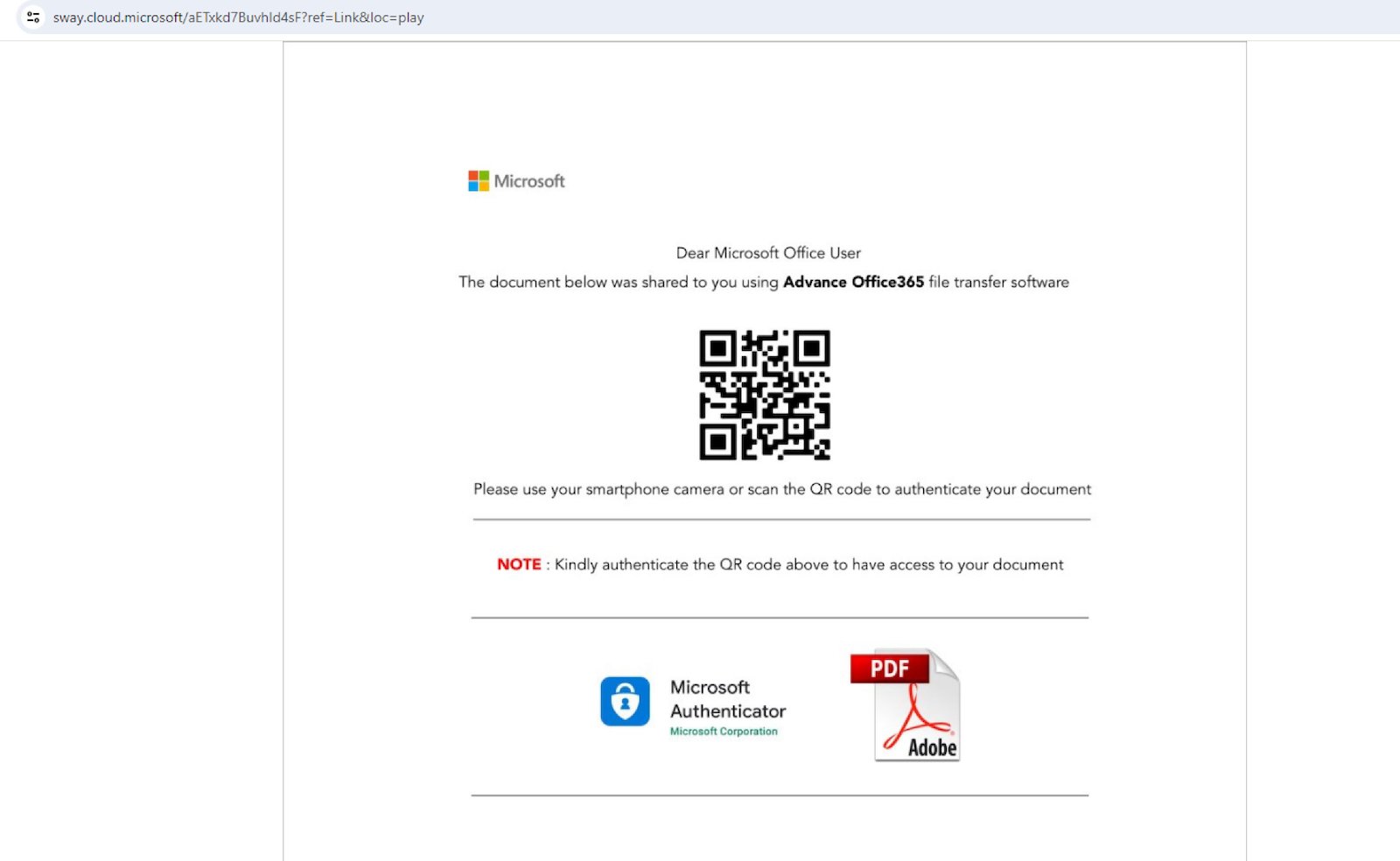
The emails redirected potential victims to phishing landing pages hosted on the sway.cloud.microsoft domain, pages that encouraged the targets to scan QR codes that would send them to other malicious websites.

Attackers often encourage victims to scan QR codes using their mobile devices, which typically come with weaker security measures, thus increasing the chances of bypassing security controls and allowing them to access phishing sites without restrictions.

“Since the URL is embedded inside an image, email scanners that can only scan text-based content can get bypassed. Additionally, when a user gets sent a QR code, they may use another device, such as their mobile phone, to scan the code,” the security researchers explained.

“Since the security measures implemented on mobile devices, particularly personal cell phones, are typically not as stringent as laptops and desktops, victims are then often more vulnerable to abuse.”

Sample Sway phishing page
Sample Microsoft Sway phishing page (Netskope)

The attackers employed several tactics to further boost their campaign’s effectiveness, like transparent phishing, where they stole the credentials and multi-factor authentication codes and used them to sign the victims into their Microsoft accounts while showing them the legitimate login page.

They also used Cloudflare Turnstile, a tool intended to protect websites from bots, to hide their landing pages’ phishing content from static scanners, helping to maintain the phishing domain’s good reputation and avoid getting blocked by web filtering services like Google Safe Browsing.

Microsoft Sway was also abused in the PerSwaysion phishing campaign, which targeted Office 365 login credentials five years ago using a phishing kit offered in a malware-as-a-service (MaaS) operation.

As Group-IB security researchers revealed at the time, those attacks tricked at least 156 high-ranking individuals at small and medium financial services companies, law firms, and real estate groups.

Group-IB said that over 20 of all harvested Office 365 accounts belong to executives, presidents, and managing directors at organizations in the U.S., Canada, Germany, the U.K., the Netherlands, Hong Kong, and Singapore.

read more
Trustpilot
The rating of livingsafeonline.com at Trustprofile Reviews is 9.1/10 based on 13 reviews.
Verified by MonsterInsights